
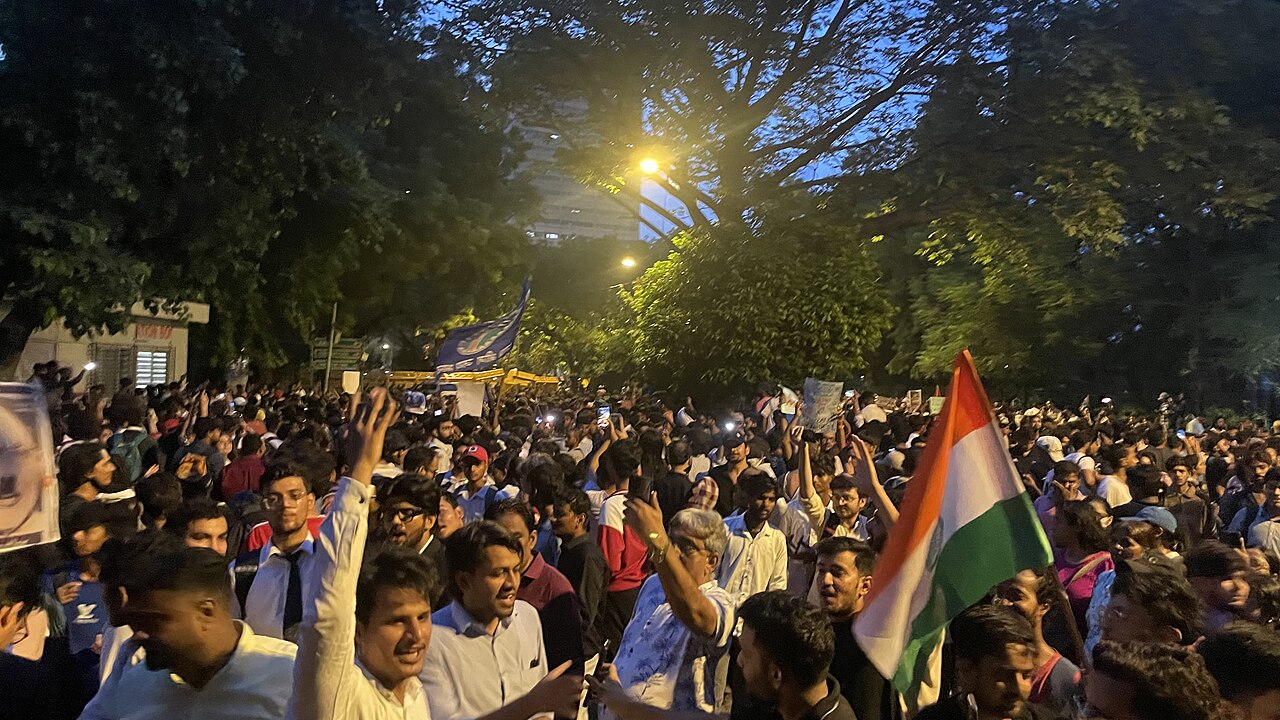
At first glance, India’s Cockroach Janata Party (CJP) appears to be little more than an internet joke. Its symbol is an insect, its members embrace the label of unemployed outsiders, and its social media posts mock the political establishment they claim to challenge. Yet the movement’s rapid rise has drawn attention to frustrations that traditional parties have struggled to address. What began as satire raises a more serious question about Indian democracy: what happens when a generation no longer believes the established political system is listening?
The movement emerged after India’s Chief Justice, Surya Kant, was reported to have compared some unemployed young people to cockroaches and parasites during a court hearing. Although the remarks were said to refer to people with fraudulent degrees rather than young people generally, they struck a nerve. Abhijeet Dipke, the movement’s founder, turned the insult into a political identity, asking what might happen if India’s supposed cockroaches came together. The resulting party attracted millions of social media followers, building a following around the idea that those dismissed by the establishment could organise against it.
The grievances behind the movement extend well beyond an isolated remark. India’s young people face intense competition for education and employment, alongside rising living costs and uncertainty about their economic futures. Concerns over corruption and institutional accountability have compounded this frustration. The cancellation of a national medical entrance examination following a question-paper leak, affecting approximately 2.3 million students, reinforced perceptions that the systems governing young people’s futures are failing them. For many, the problem is not a lack of political promises, but a perception that those promises have not translated into opportunities.
The CJP’s unconventional approach is central to its appeal. Rather than compete with established politicians on their own terms, it uses memes, absurdist slogans and self-deprecating humour to turn frustration into a shared political identity. The cockroach becomes a symbol of resilience, representing people who survive through difficult conditions despite being treated as disposable. Humour also allows political criticism to reach audiences who might otherwise remain disengaged from conventional political debate. By transforming an insult into a rallying point, the movement makes dissent accessible without requiring supporters to identify with an established ideological camp.
Yet the movement’s significance is not confined to the internet. Its supporters have taken their grievances into the streets, demonstrating how online enthusiasm can translate into organised public pressure. Campaigns over education and government accountability have sought to turn viral attention into concrete demands. This complicates the assumption that digital activism is necessarily superficial: even a movement without the resources of a major political party can attract attention to issues that established institutions would prefer to manage on their own terms.
The CJP also exposes a broader tension within India’s political culture. The democratic country has many systems for political participation, and a long history of mass mobilisation—from anti-corruption campaigns to farmers’ protests. But democratic elections do not necessarily capture every form of public dissatisfaction. Prime Minister Narendra Modi’s Bharatiya Janata Party has dominated national politics since 2014, while opposition forces have struggled to present a consistently unified alternative. A movement such as the CJP can therefore attract people who oppose particular policies but do not identify with existing parties. Its appeal lies partly in its refusal to fit neatly into the political categories through which dissent is usually expressed.
There are, however, limits to what the movement can achieve. A large social media following is not equivalent to an electoral mandate, and anger over a particular scandal does not automatically produce any coherent political results. The CJP’s ability to mobilise around unemployment and education does not guarantee agreement on India’s wider economic or constitutional questions. Nor is it clear whether it can sustain the organisation required to exert pressure beyond individual campaigns.
Still, the CJP’s importance should not be measured solely by whether it becomes a registered political party or wins elections. Its rise suggests that political participation is evolving alongside the platforms through which young people communicate. When traditional institutions appear unresponsive, satire and online communities can become alternative means of articulating grievances and demanding accountability.
The Cockroach Janata Party, then, is neither simply an internet fad nor proof of an imminent political realignment. It reflects a more complicated relationship between citizens and the institutions that claim to represent them. Its supporters have turned an insult into a symbol and humour into a vehicle for dissent. Whether that energy can be sustained remains uncertain. But the movement demonstrates that when people feel excluded from conventional political discourse, they may not withdraw from politics altogether. They may instead find new ways to make themselves heard.
Aiyana Kaul is a staff writer for On The Record from London, UK and a sophomore in the SFS studying IPOL.