
Are National Guard deployments worth it?
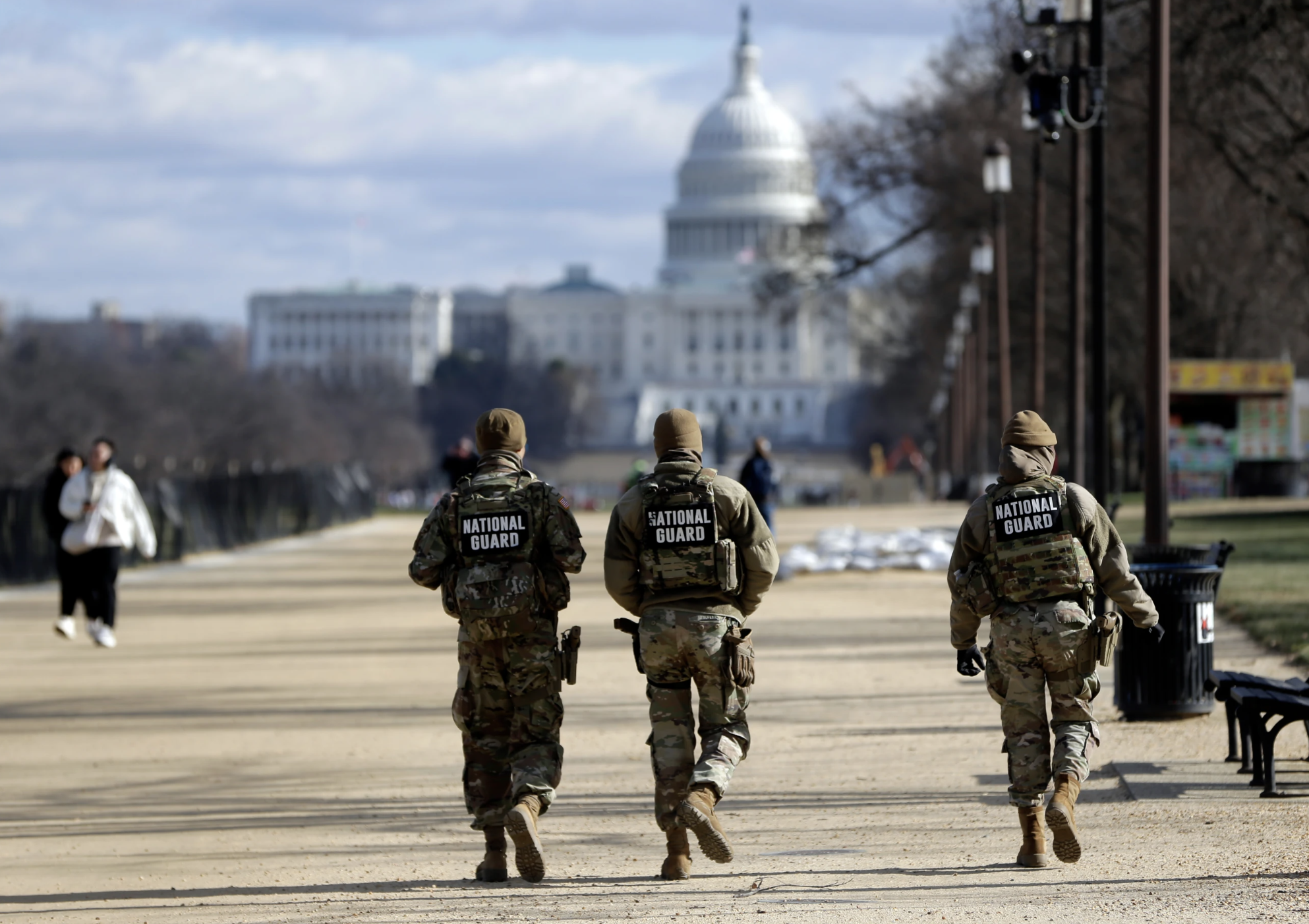
Three National Guardsmen walk down the National Mall. (Photo via AP News)
LUCAS HAYDEN: As National Guard deployments quietly packed up and left in Chicago, Portland, and Los Angeles, they left an undoubtedly controversial wake behind them. Many of the residents they were there to protect—alongside Americans around the country—are wondering the same thing: was it worth it?
The National Guard are state-based military contingents that can be activated by a governor, or by the Department of War and the President if certain circumstances are met. Trump has pointed to statute 10 U.S.C. § 12406 as justification for these deployments. The statute says that a president can deploy the National Guard to execute the laws of the United States, or to stop rebellions or invasions by foreign powers. The key question faced by judges examining the constitutionality of such deployments is whether or not cities are facing rebellions, and if rule of law is able to be upheld without Guard units present. The President threatened to invoke the Insurrection Act—which would grant him broader authority to deploy active-duty military and National Guard units—to crack down on protests in Minnesota following the killing of Renee Good, but ultimately backed down.
Nonetheless, the Trump Administration has been mobilizing, deploying and withdrawing Guard units since last Summer after declaring that crime in certain cities across the country was out of control. The first city where the Guard held a major presence was in Los Angeles, where images of protestors clashing violently with federal agents over an immigration crackdown reached the entire world. Since then, several cities came under, and still remain under, the protection of the Guard. The National Guard was set to exit New Orleans at the end of February but their stay has been extended till at least August. Meanwhile, deployments remain in Memphis and Washington, neither of which currently have a definitive exit date. The detachment in Washington will remain until at least 2027.
For starters, cost must be taken into account. The nonpartisan Congressional Budget Office estimates that by the end of 2025, deployments by the National Guard to the aforementioned six cities alone cost roughly half a billion dollars. The Guard cost $93 million monthly to maintain at their end-of-2025 capacity and size, meaning that even with the withdrawal of Guard from three cities the total cost at the end of February reached nearly $700 million.
That is certainly a high price tag—but one that could be at least partially forgiven along with a solid crime reduction, which has been a central pillar of this administration’s justification for deployment. Unfortunately, it is fairly hard to differentiate causation from correlation on this front. The homicide rate in Memphis, Washington and New Orleans have steadily dropped 32%, 54%, and 44%, respectively since 2023. That is long before the Guard were deployed under the Trump Administration, and the deployment of the Guard has yet to observably accelerate the slump of crime rates in most of the deployed cities. Similar steadily downward rates exist for the cities that the National Guard has pulled out of. President Trump’s State of the Union claims that the homicide rate in Washington is down 100% since the Guard’s deployment has, unfortunately, little basis.
In two cities, Chicago and Portland, National Guard troops were never greenlit to operate throughout the city at all. They were merely deployed to support other federal agents, namely Immigrations and Customs Enforcement, and protect federal buildings. There were no serious incidents of vandalism in federal buildings while National Guard troops were deployed in Chicago. Portland has observed federal agents repeatedly clashing with protestors outside an ICE facility in Southern Portland, with numerous acts of vandalism occurring, but federal buildings throughout the rest of the city remain relatively secure.
In Washington, many members of the Guard have been assigned to a litter pickup operation. The last published statistic of trash picked up (around one thousand bags) comes from September, but many sites throughout the city, particularly monuments, have become noticeably cleaner since the deployment of the Guard. Students that have taken Metro recently have likely also seen patrols in subway stations. All in all, between last August and January the Guard in DC logged roughly one thousand Significant Activity reports, which can consist of “observations recorded, suspicious items reported, medical concerns identified, (and) coordination completed with partner agencies,” according to a DC National Guard news release. Notably, guardspeople in DC have also largely stayed out of the news as far as violent confrontations go, likely due to a more supportive and observatory role propping up the actions of local law enforcement. The longer they stay in Washington, the more integrated they will become with the city, and the easier it will be to maintain a presence with whatever role they choose.
At the end of the day, it remains up to the common voter whether or not these deployments are worth their money. However, in the meantime, there is no shortage of trash to pick up in Washington.
Lucas Hayden is a freshman from St. Louis majoring in International Politics at the School of Foreign Service.