
Maybe we know too much about politics.
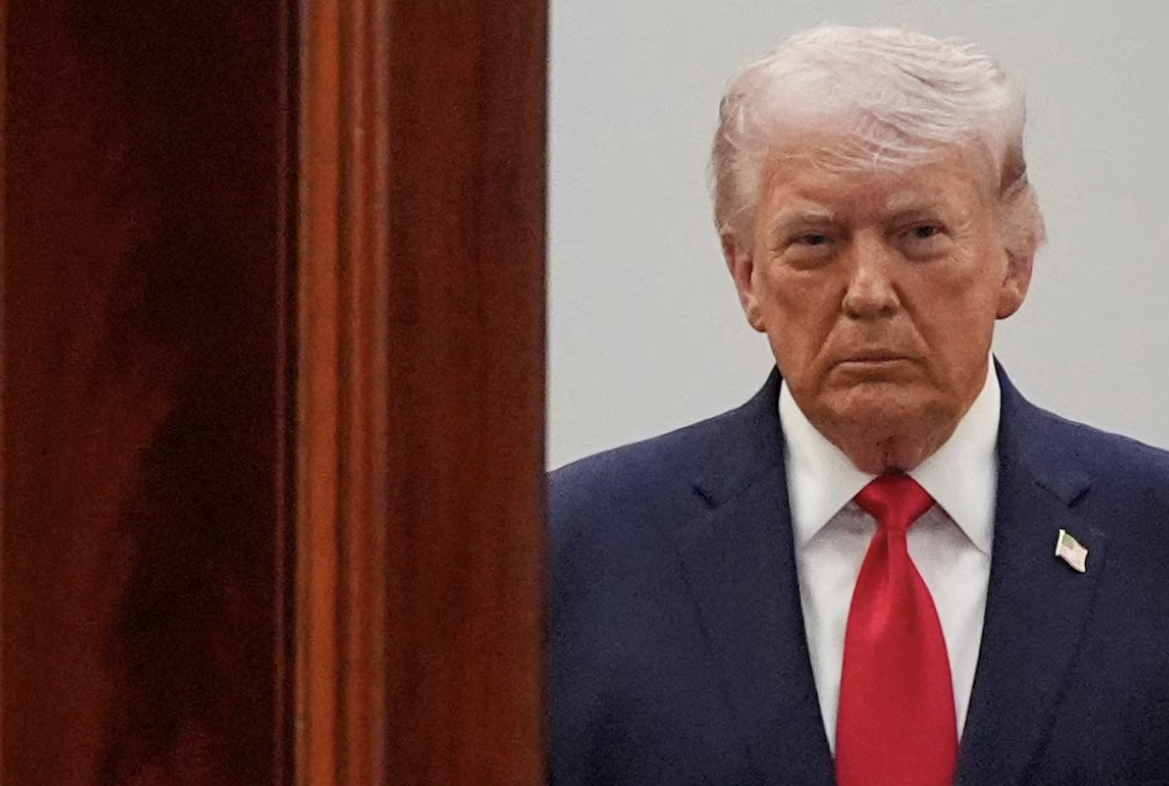
Photo via Reuters
PATRICK MCFARLAND: What I learned from a visit to a Trump Store in suburban Pennsylvania raises a question about political obsession — and whether we’re paying attention to the appropriate things.
On a dreary January morning, I found myself in Bensalem, Pennsylvania, a township north of Philadelphia that blends seamlessly into the suburban American landscape: chain stores, fast food, and outlet stores. Bensalem sits near one of the original Levittown communities, the mass-produced housing developments that helped suburbanize America after World War II. The bones of postwar optimism are still there if you squint. Mostly, though, you see Street Road.
Pennsylvania Route 132 a divided state highway goes by the wonderfully literal name Street Road, and it was there, tucked between Rinconcito Hispano, a convenience store, Hunan Delight, a chinese fusion takeout, and Jerusalem furniture outlet lies the Trump Store. Part gift shop, part shrine, the space offered the full range of MAGA souvenirs — hats, flags, branded merchandise — alongside a small memorial corner dedicated to Charlie Kirk, the founder of conservative youth organization Turning Point USA. The atmosphere was not bleak or depressing: people milling around, sharing memories, wishing each other well. By the end of January, the store would close its physical location and transition to an online presence, becoming a vendor on the fair circuit, my visit in the final days of the store's physical location was not farewell but a transition. As the Trump store would transition from a physical place to a larger online presence, we are seeing a transition in the legacy of Trump’s time in office what is next for MAGA remains uncertain, but the 2026 midterms are not only a referendum on his six years in office but pivot to what is next for this aspect of the american conservative movement.
What makes Bensalem — and the county it sits in, Bucks County — genuinely interesting is where it stands politically. This is not the MAGA Hamptons of the rural Missouri Ozarks, where Trump stores blend into the terrain. It’s not Pigeon Forge, Tennessee, where the gift shop economy runs on a certain kind of patriotic nostalgia. Bucks County is a swing county, the kind of place elections are actually decided. Hillary Clinton narrowly won the county in 2016 by about 2,700 votes. It swung farther left four years later, giving Joe Biden a margin of more than 17,000 votes in 2020. In the 2022 midterms, the county backed Democrats Josh Shapiro for governor by nearly 20 points and John Fetterman for Senate by 7 points. Then, in 2024, it flipped: Trump carried Bucks County by roughly 1,300 votes, the first Republican presidential candidate to win the county since George H.W. Bush in 1988. The Trump Store on Street Road wasn’t a relic of some permanently red corner of the country. It was planted squarely in one of the most contested patches of ground in American politics.
Although the patrons were cautious and unwilling to speak on the record, they could not have been more friendly and hospitable. Between reminiscences about Kirk and the 2024 Trump campaign, people were willing to talk politics with a stranger. The patrons were engaging. And felt like Trump was delivering on his promises. The mood was triumph with a twinge of nostalgia, like the feeling on the last day of school or at the end of a state fair. The mood when something good has run its course and it’s time to move on.
Then the conversation turned to the future. What is the future of Trumpism? Who comes after Trump? JD Vance came up more than once. A few people mentioned Erika Kirk, Charlie’s widow. Surprisingly, I never heard Tucker Carlson as a candidate. I heard his name mentioned but not as a successor, and even more surprisingly no one mentioned Marco Rubio.
I was visiting only weeks after what I thought was a significant moment in Rubio’s tenure as secretary of state: the symbolic capture of Venezuelan dictator Nicolás Maduro and his wife. Despite this initial triumph for the Trump administration in foreign policy, Rubio's name didn’t register with any of those visiting the Trump store. I drove home wondering: is it possible that I know too much about politics?What does it mean to be politically aware? In an era when people can’t agree on the facts or even share the same news, when one says they are policy wonk or a news junkie what do they mean? If you are not even talking to those you disagree with or worse simply lobbing talking points at the other side, what is the point of being politically literate in 2026?
This can sound like an obnoxious humblebrag. “Oh, I’m too plugged in, it’s such a burden.” That’s not what I mean. What I mean is something more uncomfortable: the things political obsessives like me track closely — the secretary of state’s diplomatic wins, redistricting battles in states I don’t live in, the internal power dynamics of a party’s donor class — may have very little to do with how most people actually experience or think about politics.
According to the Pew Research Center, about 19 or one in five Americans, had not heard of Marco Rubio. That means roughly 80 percent had, which, in a vacuum, sounds like strong name recognition for the nation’s top diplomat. But consider what Rubio has accomplished: he’s the first Hispanic Secretary of State in American history, confirmed unanimously 99–0 by the Senate, and has been so involved in foreign policy that the New York Times took to calling him the “Secretary of Everything.” He ran for president in 2016. He’s been a national figure for fifteen years. And still, one in five Americans draws a blank. That same Pew survey found that Defense Secretary Pete Hegseth — a far more controversial figure who dominated news cycles for weeks during his confirmation fight — was unknown to nearly a third of Americans. Not unpopular. Unknown. A third of the country had simply never encountered his name.
This is not new. Survey after survey over the years has found that substantial portions of Americans cannot name their own representative in Congress, don’t know which party controls the Senate, or can’t identify the three branches of government. Civic literacy tests that seem embarrassingly easy to the politically engaged routinely stump large majorities. We tend to treat this as a failure of education, attention, or patriotism. But maybe we’re framing it wrong.
The people in that Bensalem strip mall weren’t ignorant. They were engaged. They voted, they cared, they had strong opinions and could talk about them at length. But the political figures they knew weren’t cabinet secretaries. They were personalities. They knew Charlie Kirk. They knew Tucker Carlson. Not because these people hold any formal power but because they’re on screens, guests on podcasts, and they are compelling personalities. If you haven’t seen Tucker Carlson and Theo Von rant about nicotine pouches and smoking, go to Youtube and enjoy the next nine minutes. They are ambient noise in a chaotic world.
It’s not like my fellow liberals do not do this too, look at the canonization of Stephen Colbert, or denouncing Bill Maher for going to dinner with Trump and Kid Rock. Members of my family get their takes from The View, and I have classmates who only share takes from Pod Save America, Jon Lovett, and The Bullwark, because they match their righteous outrage. I am probably one of the only people who enjoys listening to both Rachel Maddow and Tucker Carlson. After all, their rhetorical style is similar, and let’s not forget they used to be friends and sparring partners before Tucker jumped off the antisemitic deep end.
This is the landscape we live in: one where political celebrity has largely displaced institutional knowledge. You might not know who your congressman is, but you know your side’s entertainers and your villains. You know the people who make you feel something — validated, outraged, energized — far better than you know the people who are quietly shaping policy on your behalf. In a strange way, this makes sense. Emotional engagement requires less effort than institutional comprehension, and it’s more consistently rewarding.
The people who told me Vance or Erika Kirk might be the future of Trumpism weren’t wrong to think in those terms. Trumpism has always been as much a cultural phenomenon as a political movement, maybe more. The movement produces its own celebrities, and those celebrities carry more weight in the minds of its adherents than any diplomat or cabinet secretary. Policy matters, but the question of “who creates it” is almost beside the point for most voters. They’re tracking the vibe, not the political depth chart.
So do I need to touch grass? Probably. We all do. But the more interesting question isn’t whether the politically obsessed know too much. It’s whether we know the wrong things — tracking the political depth chart, or becoming a Supreme Court wonk, while the culture moves on without us, studying the cabinet while the culture shifts in a strip mall in Bensalem. The patrons of that Trump Store weren’t unaware of politics. They had a perfectly coherent read on their world. It may have not been a political stance that I shared, but for the most part we could share a pleasant conversation about politics, their perspective, and if I am honest it would have been based on their facts, it may have not been my perspective of the world but that doesn’t make it any less legitimate.
For those of us who pride ourselves on knowing who the Secretary of State is, get excited about British by-elections, and make hedge bets on Canadian Cabinet shake ups. My experience at the Trump Store may be something worth mediating on rather than spending time on making sure we have correct facts, maybe we are open to others' perspectives, and make sure that we also have the right facts.
Patrick is a final-year graduate student, completing a master's in journalism in the School of Continuing Studies. His focus has been on the intersection of politics and culture across local, regional,and national communities. When he is not busy, he tries to infuse humor into his work by performing stand-up comedy, taking in audiobooks, convincing people that CDs are the new vinyl, and enjoying walks.